How Diet Affects Neurotransmitters
Explore this webpage to get a better understanding of how the food we eat can affect the chemicals in our brains!
Group work done by Lilly (Hilliary) Cummings, Shayonce Graham-Davidson, Jessica Jackson, Harem Khan, Teana Nassir
How Diet and Food Affects the Brain
The foods that we consume on a regular basis affects our bodies in ways that we wouldn’t always expect. To be specific, the diets that we maintain have a direct relationship with the neurotransmitters that are released in the brain. For example, the proteins in our foods are broken down during the digestion process. Because of this, amino acids are broken down and increase the production of neurotransmitters. Amino acids come from proteins such as eggs and poultry.
Neurotransmitters such as dopamine and epinephrine are known for their ability to increase levels of alertness and energy. There are also neurotransmitters, such as epinephrine, that produce negative effects on the body. Epinephrine is released when a person is stressed or scared, that causes an increase in heart rate and breathing.
In life people always hear the fact that you have to eat right, and that healthy eating is important for you. This is why when people have kids, they have a tendency to make sure that their children are eating healthy. What people do not know is that the food that we eat actually has a deeper effect on our bodies and on our health rather than just external factors. For example, some people will stop eating junk food because they do not want to gain weight, or they do not want their face to break out in acne, but that junk food is actually also bad for our overall health and our mental health.
Most foods that we eat are made up of multiple nutrients. How these nutrients interact with one another determines the production and release of neurotransmitters. The nutrients in the food play as the prosecutors. Depending on the amount of prosecutors present in the food you eat the more or less of a neurotransmitter is released.(Ross, A. P., et al., 2013).
Research has concluded that Western style diets (common to Canada and USA) are rich in saturated fats and refined sugars, and low in fiber, fruit and vegetables (Attuquayefio, et al., 2016). These types of foods impair the ability of the hippocampus. With these foods, the hippocampus will lack the ability to appropriately inhibit food-related memories under a physiological state, which also promotes energy regulation, leading to obesity (Attuquayefio, et al., 2016).
Additionally, everyday diets can disturb cognitive functioning and increase one’s susceptibility to neurodegenerative conditions (Hargrave, et al., 2016). To determine these facts, a study was conducted on rats. Half ate chow or saturated fats and others ate dextrose. Through the study it was concluded that response animals had significantly higher plasma insulin levels (Hargrave, et al., 2016). Having higher plasma insulin levels has been linked to obesity, heart disease, and cancer.
An excessive intake of calories from fats and sugars (high energy diet; HED) negatively impact hippocampal dependent memory. Caloric intake has increased by approximately 28% due to the disproportionate intakes of energies from the variations of food one eats. This results in the decrease of neural growth factors and synaptic plasticity (Ross, A. P., et al., 2013).
Today, going to the gym, being healthy, and eating right is something that seems to be more important to people and is something that people tend to focus on, but what they do not focus on is the future effects that certain foods have on us. It is important to know what foods benefit specific areas of our bodies and brains because we will be able to fuel ourselves with the necessary foods that will help us not only last throughout the day, but also help our health overall.
Certain foods not only help with our physical health and neurotransmitter release, but they also play a role in our mental wellness as well, which all have a direct link between each other. In an experiment done to test the association between habitual tryptophan intake and depressive symptoms in young and middle aged women, it was determined that mothers with depressive symptoms were likely to have a lower physical activity level, smoking habit, more experience of divorce or loss of their husband, lower perceived health status, higher level of stress, higher mean intake of energy and lower mean intake of tryptophan and folate. Also, that students with depressive symptoms were likely to have a lower perceived health status, higher level of stress, higher mean intake of energy, and lower mean intake of tryptophan and folate (Suga, 2018)
Tryptophan is an essential amino acid that supposedly affects serotonin availability. Serotonin heavily affects our mood and lack of it can affect depression (Suga, 2018) . The study of the association between habitual tryptophan intake and depressive symptoms is a three-generational study that involved participants doing a diet history questionnaire (Suga, 2018). The tryptophan intake was then calculated as well as depressive symptoms. The results specifically showed that a lower prevalence of depressive symptoms in women was connected to a higher tryptophan intake (Suga, 2018).
All over the world, food is an important aspect of human life and culture. Whether it’s the benefits of a mediteranean diet on cognition or the lack of tryptophan connecting to depression in Japanese women, all food affects our brain and body. Food is something we need to survive and cannot live without. That is why it is so much more important to understand what we are eating and putting into our bodies. Some foods may have more negative than positive effects and we fail to realize it.
Growing up hearing that you have to eat healthy food is something that people like to ignore and do not understand as to why it is important. Eating healthy not only improves one’s mood, but it also improves one’s mental, physical, emotional, and social health.
Self Reflection and Take-Home Message
In terms of self reflection, as a society we don’t consider the foods that we put into our bodies on a daily basis. Some of us are more conscious of what they consume to avoid things such as heart issues, diabetes, etc. We tend to overlook the fact that our everyday eating habits can also affect neurotransmitters that benefit our mental wellness, which should be just as important as our physical health.
In addition to not considering what we put in our bodies, it is important to reflect on the fact that there are some other factors contributing to a lack of ability to have a certain diet. These factors can include lack of accessibility and lack of funds. This creates a problem when people only have the option of fatty, salty, and non nutritious foods because they are stuck in a cycle that is very hard to break out of. The people most affected by this are people of colour and people of low socioeconomic status (Raffensperger, et al., 2010).
What we should consider taking home from this information is the importance of the nutrients that we put into our bodies. The brain requires an efficient amount of energy that can only be derived from the foods we eat. What you eat will impact your mood and your cognitive function in one way or another. Therefore, it is important to have a healthier diet so that it can positively affect your neurotransmitters.
There is a reason that when a person is diagnosed with certain mental illnesses, one of the recommended treatments is to start having a better diet. Because the things that we eat directly impact the release of neurotransmitters, eating foods that encourage the release of NTs such as dopamine, serotonin, etc. will drastically improve how people with mental illness function in daily life. For example, one study concluded that the intake of tryptophan increased depressive episodes up to 50% in young women and over 25% in middle aged women (Suga, et al., 2018).
It is important to understand and pay attention to what we put into our bodies and how its effects may often go unnoticed. We do not see what goes on in our brains and for that reason we are not aware of how the food we intake affects our whole body. It is significant to remember that food does not only affect our physical bodies. It affects our mental health, our mood, behaviour, memory and entire brain and life overall. For that very reason, we need to watch what we put into our bodies, eat healthy and take care of our brain and ourselves.
Work Cited
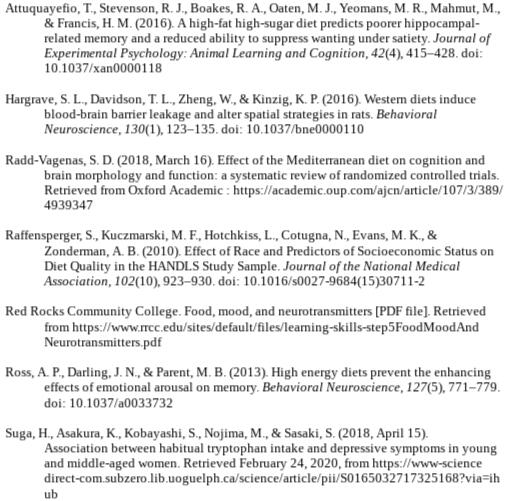
Scholarly Article Summaries
1) A High-Fat High-Sugar Diet Predicts Poorer Hippocampal-Related Memory and a Reduced Ability to Suppress Wanting Under Satiety
Western style diets are rich in saturated fats and refined sugars, and low in fiber, fruit and vegetables. Such foods impairs the ability of hippocampus to appropriately inhibit food-related memories under a sated physiological state, which subsequently promotes energy regulation and thus obesity.The study was completed through a variety of questionnaires. Participants were then given the major tasks of food cue tasks, a think/no-think task, and a palliative food cue. The study resulted in female participants tended to have lower DFS scores than men and greater dietary restraint. Hunger ratings tended to be higher and fullness ratings lower in participants reporting a higher DFS score, for energy consumed at lunch, both overall, and for each food-type, there was a tendency for this to be higher in participants reporting a higher DFS score. Mood ratings happiness ratings significantly increased across the study and sadness ratings decreased and participants also reported feeling more relaxed.
2) Western Diets Induce Blood-Brain Barrier Leakage and Alter Spatial Strategies in Rats
A Western diet (WD) is high in saturated fats and other unhealthy food and is directly linked to the development of obesity and neurodegenerative diseases. The study examined the many effects of a WD on hippocampal-dependent cognitive functioning and the brain barrier (BBB) along with how permeable it is/will become. There were 4 study groups created in order to measure certain things such as diet, body weight, duration of diet exposure, cognitive performance, and BBB permeability. Subjects were placed in a spatial learning apparatus and were expected to navigate the maze like contraption. The use of hippocampal-dependent or hippocampal-independent strategies in male rats following prolonged exposure to a WD rather than a rats typical diet was assessed to find increased BBB leakage, higher levels of obesity, elevated plasma insulin levels, and more.
3) Effect of the Mediterranean Diet on Cognition and Brain Morphology and Function: A Systematic Review of Randomized Controlled Trials
Observational studies of the Mediterranean diet suggest cognitive benefits, potentially reducing dementia risk. The first published review to our knowledge was performed of randomized controlled trials investigating Mediterranean diet effects on cognition or brain morphology and function. Analyses were based on 66 cognitive tests and 1 brain function outcome from 5 included studies. Found that the Mediterranean diet modulates the effect of several genotypes associated with dementia risk for some cognitive outcomes, with mixed results. All studies provided some advice on the intake of fruit, vegetables, and fish and seafood. 4 studies advised on the use of fats other than olive oil. 4 also gave recommendations for the consumption of nuts, dairy, sweets, and sweetened drinks. Both qualitative and quantitative advice was provided by 3 studies for the intake of wine and by 4 for red or processed meats. However, only 2 studies provided this level of comprehensive guidance for consumption of olive oil, legumes, and eggs. Four out of 5 studies provided some recommendations on poultry but only 3 of these specified how much to consume. There is currently inconsistent empirical evidence for significant benefits of the Mediterranean diet for cognitive function. No empirical data has been reported linking this diet to brain morphology or connectivity. However, significant and clinically meaningful ESs were found for cognitive composites in the largest and most robust trial, indicating promising scope for future well-designed trials.
4)Association Between Habitual Tryptophan Intake and Depressive Symptoms in Young and Middle-Aged Women
Tryptophan is known as an essential amino acid, and is assumed to affect serotonin availability. A cross-sectional study was conducted as a part of the three-generation study of women on diets and health to illustrate the association between tryptophan and depressive symptoms in young and middle-aged japanese women. After exclusion, 4272 students and 3651 mothers participated in the study. A self-administered diet history questionnaire was used to assess dietary nutrient intake for the following month and estimates of dietary nutrient and tryptophan intake were calculated using computer algorithm. Also, depressive symptoms were assessed using a japanese version of the center for epidemiologic studies. The study found that prevalence of depressive episodes was 50% for young women and 26.5% for middle aged women. The students with depressive symptoms were more likely to have a lower perceived health status, higher level of stress, higher mean intake of energy, and lower mean intake of tryptophan and folate. Similarly, mothers with depressive symptoms were more likely to have a lower physical activity level, smoking habits, more experience of divorce or loss of their husband, lower perceived health status, higher level of stress, higher mean intake of energy and lower mean intake of tryptophan and folate. Overall, the study found that in young women, a higher tryptophan intake was independently associated with less depressive symptoms.
5)High Energy Diets Prevent the Enhancing Effects of Emotional Arousal on Memory
An excessive intake of calories from fats and sugars (high energy diet; HED) negatively impact hippocampal dependent memory. Caloric intake has increased by approx 28% due to disproportionate intake of energies from saturated fats and refined carbohydrates. These effects involve decrease in neural growth factor and synaptic plasticity. The Male Sprague Dawley Rats aged 53 days were fed HED cafeteria style diets for 4 weeks. Followed by a test in low and high emotional arousal version of spatial object place recognition task, memory test and total object exploration. On the first day of experimentation rats were weighted and fed standard chow for 1 week. On the seventh day they were weighed again to compare it to the original body mass when the rats first arrived. Results from all three tasks indicated that increased percentage change in body mass, diet did not affect retention test or interact with effects from prior habituation in task with good discrimation scores. Lastly rats previously habituated to the apparatus spent more time exploring the objects than did non habituated rats did.